Q2 2026 Air Freight vs. Ocean Freight
When does air freight stop being a luxury and start saving money? The Carrying Cost formula that turns the air-vs-ocean decision into math.
ByJason Kim · Branch Manager · 15 years in freight forwarding · Los Angeles · Frankfurt · Chicago
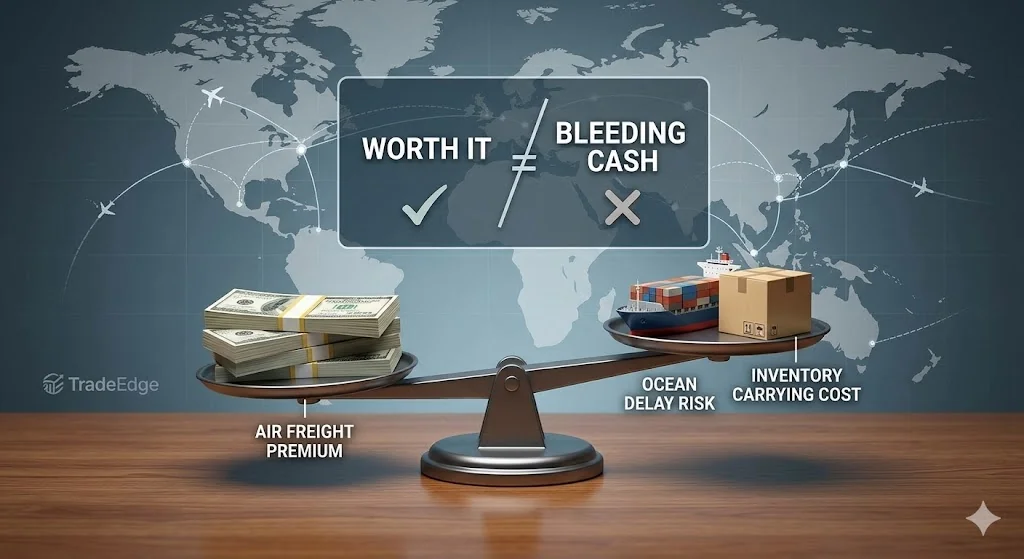
One of the most frequent questions I get from importers is: "When should I pull the trigger on air freight?" In a vacuum, the answer is easy—whenever you're in a rush. But in the high-stakes environment of Q2 2026, where ocean capacity is in a state of flux and "Net/Net" margins are tighter than ever, the decision requires a more clinical approach.
In my 15 years managing freight from the West Coast to the European hubs, I’ve seen companies go bankrupt by overusing air freight as a "panic button." Conversely, I’ve seen them lose major retail accounts by being too stubborn to move off the water when conditions soured.
The secret isn't just about speed; it's about the Cost–Risk–Time equation. Here is the practitioner’s guide to knowing when that air freight premium is actually a smart investment in Q2 2026.
The 2026 Q2 Market Reality
As we move into the second quarter of 2026, we are seeing a "bumpy" airfreight landscape. While passenger belly-hold capacity is increasing with summer flight schedules, dedicated freighter space remains structurally constrained. Meanwhile, on the water, the fragmented and selective return to Suez Canal transits has created a "policy cliffhanger," where carriers are split between the Red Sea and the Cape, leading to unpredictable lead times and short-term port congestion in the Mediterranean.
If your cargo is stuck in a "vessel reshuffling" delay, you aren't just losing time—you're losing capital. Here is how to calculate if you should pivot to the sky.
The Math: Inventory Carrying Costs vs. Air Premium
Most logistics teams only look at the freight invoice. To make a branch-manager-level decision, you have to look at the carrying cost. In 2026, the average inventory carrying cost is roughly 20% to 30% of the product value per year.
When your goods are sitting on a vessel for 45 days instead of 5 days on a plane, you are tying up capital, paying insurance, and risking obsolescence. For high-value electronics, AI components, or fashion with a 6-week shelf life, the carrying cost of a 40-day ocean delay often exceeds the cost of an air freight charter. If the cost of holding that inventory is higher than the air freight premium, air is actually the cheaper option.
3 Scenarios Where Air Freight is the Correct Move
- 1. The "Peak Season" Insurance: With Q2 2026 manufacturing volumes in Asia remaining resilient, missing a seasonal retail window (like Back-to-School replenishment) can result in a total loss of revenue. In this case, air freight isn't a premium; it’s an insurance policy for your market share.
- 2. High Value-to-Weight Ratio: If you are shipping semiconductors, medical devices, or specialized industrial components, the freight cost is a negligible percentage of the total product value. Air freight provides a level of security and reduced handling that ocean simply cannot match for "high-care" cargo.
- 3. The "Line-Down" Emergency: If a missing industrial chiller part is holding up a multi-million dollar construction project in Texas, the $5,000 air freight premium is irrelevant compared to the $50,000-per-day "liquidated damages" penalty for a stalled project.
The 2026 Strategic Play: The Sea-Air Hybrid
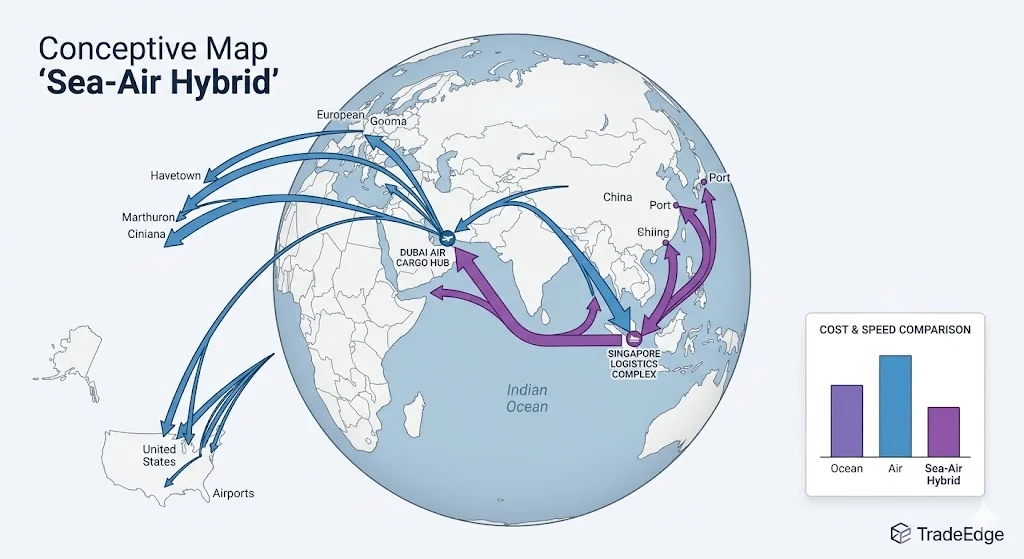
Forward-thinking importers are increasingly moving toward Sea-Air hybrids —routing cargo by ocean to a hub like Dubai or Singapore, then switching to air for the final leg. This offers a middle ground: it’s 50% faster than ocean but 40% cheaper than pure air freight. In a year defined by 2026 trade volatility, agility is your best asset.
The TradeEdge Takeaway: Don't treat air freight as an emergency failure. Treat it as a strategic lever. When the ocean market is volatile, use the Carrying Cost formula to prove that speed isn't just a luxury—it’s a financial necessity for your bottom line.