How to Classify One Product Step-by-Step: From Description to 10-Digit Code Under HTSUS and TARIC
Step-by-step guide to classifying a product under HTSUS and TARIC. GRI rules, real example, and the trap that costs first-time importers thousands.
In Fiscal Year 2025, U.S. Customs and Border Protection recovered $26 billion in additional duty from entry summary reviews — the audits CBP conducts to confirm imported goods were correctly classified and valued.
The year before, that number was $667.5 million.
That is a 39× jump in twelve months.
If you import into the United States and have not changed the way you classify your products, you are walking into the most aggressive customs enforcement environment in modern American trade history armed with a 10-digit code that you probably guessed.
This post is the antidote.
Why I'm writing this now
There are roughly 11,000 licensed customs brokers in the United States. There are nearly 25,000 freight forwarders. There are millions of importers and exporters.
Almost none of them can find a straight answer to a simple question: how do I classify my product without getting screwed?
I've worked international freight forwarding for over fifteen years — nine at LAX, six and a half at FRA (Frankfurt, Germany), the last few at ORD as Branch Manager in the Chicago area. Across those years I've watched cargo move through Los Angeles / Long Beach, Hamburg, Rotterdam, Antwerp, and Bremerhaven. I've seen what gets people hurt.
Classification is what gets people hurt the most. Not freight rates. Not Incoterms. Not even fuel surcharges.
This post walks you through how to classify one product correctly , the same way a customs broker would — using the General Rules of Interpretation (GRIs), the actual tools the agencies publish for free, and the same logic whether you're importing into the US or exporting to the EU.
We'll use one working example all the way through: a stainless steel water bottle.
And here's the twist that makes this post worth reading: depending on whether your bottle is single-walled or vacuum-insulated , the same-looking product lands in completely different chapters of the tariff schedule — Chapter 73 versus Chapter 96. Different duty rate. Different regulatory regime. More than triple the duty for getting one construction detail wrong.
By the end, you'll have a 10-digit code for the US side (HTSUS — Harmonized Tariff Schedule of the United States) and a 10-digit code for the EU side (TARIC — Integrated Tariff of the European Union), and you'll understand why they aren't the same number — even though the first six digits are.
First, what you're actually doing
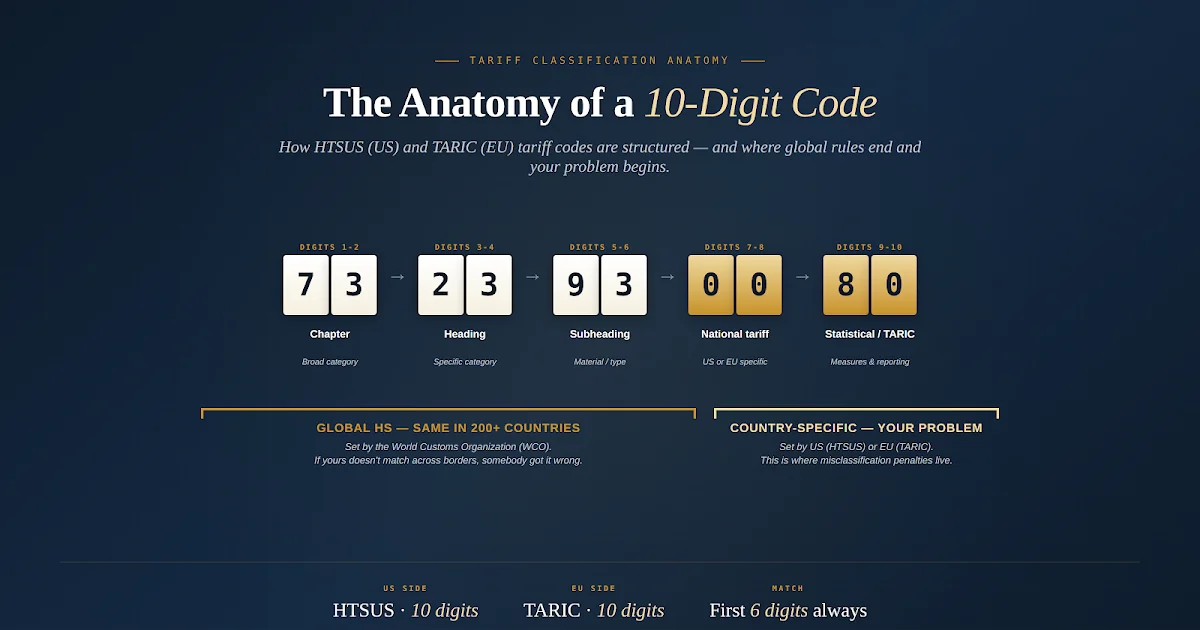
Classifying a product means matching it to one — and exactly one — line in a giant hierarchical catalog. Every country in the World Customs Organization (WCO) uses the same first six digits because they all signed onto the WCO's Harmonized System (HS) — a global standard adopted by over 200 economies.
After six digits, each country can add its own subdivisions:
- US: adds 4 more digits → 10-digit HTSUS code
- EU: adds 2 digits for the Combined Nomenclature (CN) plus 2 more for TARIC measures → 10-digit TARIC code
So the first six digits of your US code and your EU code should always match. If they don't, somebody classified wrong — and it's almost always the side closer to the cargo. That's you.
The structure, made simple
| Digit position | What it means | Set by |
|---|---|---|
| 1–2 | Chapter (broad category) | WCO (global) |
| 3–4 | Heading (specific category within chapter) | WCO (global) |
| 5–6 | Subheading (more specific) | WCO (global) |
| 7–8 | US tariff line / EU CN code | National (US) / EU |
| 9–10 | US statistical suffix / EU TARIC measures | National (US) / EU |
Your next step: Open two browser tabs right now. One to hts.usitc.gov, one to trade.ec.europa.eu/access-to-markets. Keep them open through the rest of this post. You'll need both.
Step 1: Write a complete physical description (before you touch any database)
This is where 90% of first-timers go wrong. They open the tariff database and start searching "water bottle" before they actually know what their product is.
Stop. Write down everything about it first.
For our example product, the complete description is:
- What it is: Drinkware / beverage container
- Primary material: Stainless steel (food-grade 18/8)
- Construction: ← This is the critical question. Single-walled or double-walled vacuum insulated?
- Capacity: 750 ml
- Secondary materials: Plastic carrying loop (polypropylene), silicone seal, plastic lid
- Material by weight: ~88% stainless steel, ~10% plastic, ~2% silicone
- Material by value: ~92% stainless steel
- Intended use: Household / personal use (not industrial, not laboratory)
- Country of origin: Manufactured in Italy
- Selling unit: Single bottle in retail-ready packaging
The five questions that decide the entire classification:
- What is it made of, by weight?
- What is it made of, by value?
- What does the buyer use it for?
- Is there any special function or technology? (insulation, electronics, motor, lock, filter, etc.) — this is the question first-timers skip and the one that decides everything
- Where was it made?
That fourth question is the one that will save or destroy your classification. We'll see why in Step 3.
Your next step: Before reading further, take five minutes and write the same nine-line description for your own product. If you can't — if you don't know your own product's material breakdown by weight and value — stop and call your supplier. You cannot classify what you cannot describe.
Step 2: Understand the GRIs — the rules that decide ties
The General Rules of Interpretation (GRIs) are six legal rules that tell you how to classify when more than one heading seems to apply. They run in order: you only use GRI 2 if GRI 1 doesn't resolve it, GRI 3 if GRI 2 doesn't, and so on.
For a first-time classifier, you mostly need to internalize three:
GRI 1 — Classify by the heading text and the notes
The single most important rule. Find the heading that names your product, read the section and chapter notes, and stop there if possible.
The Explanatory Notes to the Harmonized System (published by the WCO) tell you what a heading covers and what it excludes. They are not legally binding in the US, but CBP follows them as the authoritative interpretive guide. Skipping them is the most common path to a wrong classification.
GRI 3 — Composites and sets
If your product is made of multiple materials and no single heading names the whole thing, GRI 3 applies. Three sub-rules in order:
- GRI 3(a): Pick the most specific description over the more general one
- GRI 3(b): Classify by the material or component that gives the product its essential character
- GRI 3(c): If 3(a) and 3(b) don't resolve it, pick the heading that occurs last in numerical order among those that could apply
Essential character analysis comes from the WCO's Explanatory Notes and is reinforced by US case law. The Carborundum line of Court of International Trade decisions established that essential character may be determined by the nature of the material or component, its bulk, quantity, weight, or value, or by the role of the constituent material in relation to the use of the article.
GRI 6 — Apply the same rules at the subheading level
Whatever logic you used at the 4-digit heading level, you apply again at the 6-digit subheading level. Same rules, narrower scope.
The other GRIs (2, 4, 5) handle edge cases: unfinished goods, packaging, and an absolute fallback for things that resist every other rule. You'll meet them eventually. Not today.
Your next step: Bookmark these terms — GRI 1, GRI 3(b), Explanatory Notes, essential character. If you only learn five words of classification law in your life, those five are the ones you'll use 95% of the time.
Step 3: Find the right HS chapter — and watch the trap
Both work the same way: there's a search bar (keyword search) and a chapter-by-chapter browse mode. For first-timers, always browse, don't search. Keyword search will give you 40 results and no idea which one to pick. Browsing teaches you why your product belongs in one place and not another.
Scenario A: Our bottle is single-walled
If the bottle is a plain, single-walled stainless steel bottle (no insulation), here's the chapter logic:
- Section XV — Base metals and articles of base metal → yes, the product is mostly steel
- Inside Section XV, Chapter 73 — Articles of iron or steel → yes, this names household articles of steel
- Section XV Note 7 says: when an article contains two or more base metals, classify by the metal predominating by weight. Our bottle is 88% steel by weight.
GRI 1 closes the question. Chapter 73 it is.
Scenario B: Our bottle is vacuum-insulated (double-walled)
Now the trap opens.
If the bottle is double-walled with a vacuum between the walls — what most people call a "thermos" or "insulated water bottle" — Chapter 73 is not the right answer.
Why? Read the Explanatory Notes to Heading 9617 — Vacuum flasks and other vacuum vessels, complete with cases; parts thereof other than glass inners. The Explanatory Notes specifically state:
"The heading also includes double-walled stainless steel vacuum insulated thermal flasks without a protective outer case, which perform temperature retention."
So the same-looking stainless steel bottle, if vacuum-insulated, jumps from Chapter 73 (Articles of steel) all the way to Chapter 96 (Miscellaneous manufactured articles). Different chapter. Different duty rate. Different surcharge exposure.
Step 4: Find the right heading (digits 3–4)
Scenario A (single-walled): Chapter 73, Heading 7323
Inside Chapter 73, the relevant 4-digit headings include:
- 7321 — Stoves, ranges, cookers, barbecues
- 7322 — Radiators for central heating
- 7323 — Table, kitchen or other household articles and parts thereof, of iron or steel
- 7324 — Sanitary ware
Heading 7323 names our product. Household article, of steel. Done.
Scenario B (vacuum-insulated): Chapter 96, Heading 9617
There's only one heading. It is the heading.
9617 — Vacuum flasks and other vacuum vessels, complete with cases; parts thereof other than glass inners.
This heading is unusually narrow — it exists almost solely for thermos-type products. There's no risk of competing headings inside Chapter 96 once you've correctly identified it as a vacuum vessel.
Your next step: Write down the 4-digit heading number and the section/chapter notes that justify it. You'll need this for your audit defense file in Step 8.
Step 5: Find the right subheading (digits 5–6)
Scenario A: Subheading 7323.93 (Of stainless steel)
Inside 7323, six-digit subheadings break down by material and function:
- 7323.10 — Iron or steel wool; pot scourers
- 7323.91 — Of cast iron, not enamelled
- 7323.92 — Of cast iron, enamelled
- 7323.93 — Of stainless steel ✅
- 7323.94 — Of iron (other than cast iron) or steel, enamelled
- 7323.99 — Other
Scenario B: Subheading 9617.00 (the only one)
Heading 9617 has just one 6-digit subheading: 9617.00. No further break at the international level.
We've hit the first six digits in both scenarios. This is where the global HS harmonization ends and country-specific codes begin.
Your next step: Whatever 6-digit number you have on your US side, your EU side classification should start with the same six digits. If your customs broker comes back with a TARIC code whose first six digits don't match your HTSUS, ask why. There may be a legitimate reason — but it more often signals one side got it wrong.
Step 6 (US side): Drill to the full 10-digit HTSUS
Scenario A — Single-walled bottle
Under HTSUS subheading 7323.93.00, statistical breakouts include:
| HTSUS Code | Description | Base Duty Rate |
|---|---|---|
| 7323.93.00.15 | Teakettles | 2.0% |
| 7323.93.00.35 | Bakeware (not stove-top suitable) | 2.0% |
| 7323.93.00.45 | Kitchen ware | 2.0% |
| 7323.93.00.60 | Table ware | 2.0% |
| 7323.93.00.80 | Other (parts, etc.) | 2.0% |
CBP has issued specific rulings on stainless steel water bottles. In CROSS ruling N299732 (tariff classification of a 19-oz stainless steel water bottle, single-wall), CBP held the proper classification is 7323.93.00.80 — Other.
Our single-walled bottle code (HTSUS): 7323.93.00.80
Base duty rate: 2.0% ad valorem
On a $48,000 commercial shipment, that's a $960 base duty bill.
Scenario B — Vacuum-insulated bottle
Under HTSUS heading 9617:
9617.00.10 — Vacuum flasks and other vacuum vessels, complete with cases
Base duty rate: 7.2% ad valorem
(For parts other than glass inners, the code is 9617.00.60, at the same 7.2% rate.)
On a $48,000 commercial shipment, that's a $3,456 base duty bill. The misclassification penalty (typically 2–4× the additional duty under CBP's reasonable-care standard) on top of that takes the total exposure to $5,000–$10,000 on a single shipment.
Same-looking product. Same shelf at the retailer. Triple the duty plus penalty for getting the construction detail wrong.
A note on duty rate vs total landed duty
The base rate is just the starting line. On top of this, depending on country of origin and the trade policy environment, you may have:
- Section 232 steel tariffs (steel products specifically)
- Section 301 China tariffs (China-origin goods)
- IEEPA reciprocal duties (Chapter 99, subchapter III — extremely active throughout 2025–2026)
- Antidumping/countervailing duty (AD/CVD) orders
- Trade agreement preferences (USMCA, KORUS, JOC, etc.)
The HTSUS online tool shows footnotes and additional duties next to the base rate. Read them every time. The 2.0% or 7.2% base is rarely the final number.
For our Italian-origin example: no AD/CVD orders on stainless steel drinkware or vacuum flasks, no Section 301 (China-specific), but Italy is subject to current IEEPA reciprocal duties. Always cross-check the live rate in the HTSUS portal — it changes constantly.
Your next step: Once you have your 10-digit HTSUS code, take a screenshot of the live HTS page and save it with a date stamp. If CBP audits you 18 months from now, the screenshot is evidence of the rate as it existed on your entry date.
Step 7 (EU side): Drill to the full 10-digit TARIC
Scenario A — Single-walled bottle
Inside CN heading 7323.93:
- 7323.93.10 — Articles for table use
- 7323.93.90 — Other
Our single-walled water bottle is not strictly "table use" (you don't set it on the dinner table). It falls into 7323.93.90 — Other. The final two TARIC digits are 00 (no special EU measure).
Our single-walled bottle code (TARIC): 7323.93.90.00
MFN (third-country) duty rate: 2.7%
On the same $48,000 shipment, EU duty = $1,296.
Scenario B — Vacuum-insulated bottle
EU TARIC heading 9617 has the structure:
9617.00.00.00 — Vacuum flasks and other vacuum vessels, complete with cases; parts thereof other than glass inners
MFN (third-country) duty rate: 6.7%
On the same $48,000 shipment, EU duty = $3,216.
Same physical product family, dramatically different duty rate based on the construction. The EU's CN doesn't subdivide 9617 below the 6-digit level for non-parts, so the code essentially is 9617.00.00.00 for the complete vacuum flask.
Your next step: If you're shipping into the EU, also check whether your product is subject to CBAM (Carbon Border Adjustment Mechanism — applies to steel-intensive goods from 2026), EUDR (Deforestation Regulation — applies to certain commodities), or anti-dumping measures by country of origin. The TARIC tool flags these in red banners on the search result page. Don't skip the red banners.
Step 8: Side-by-side check
Here's all four classifications, side by side:
| Dimension | Single-wall US | Vacuum US | Single-wall EU | Vacuum EU |
|---|---|---|---|---|
| Final code | 7323.93.00.80 | 9617.00.10 | 7323.93.90.00 | 9617.00.00.00 |
| Chapter | 73 | 96 | 73 | 96 |
| Base duty rate | 2.0% | 7.2% | 2.7% | 6.7% |
| Duty on $48k | $960 | $3,456 | $1,296 | $3,216 |
| Governing GRI | GRI 1 | GRI 1 (via 9617 EN) | GRI 1 | GRI 1 (via 9617 EN) |
| Audit risk | Low | HIGH | Low | HIGH |
The product looks identical. The shelf at Target is one bottle next to another. The classification is in two different chapters. The duty rate triples.
If you only learned one thing from this post: read the Explanatory Notes for headings you didn't think were relevant. That's where the traps live — and where CBP is recovering $26 billion in audit revenue while it stands looking at your old entry summaries.
Your next step: Before you ship anything based on the codes you just derived, validate them against the binding ruling databases in Step 9.
Step 9: Validate before you ship
Classifications are legally binding declarations. Both CBP and EU customs let you verify them in advance, for free:
- US: Request a CROSS ruling at rulings.cbp.gov. Search the database first — chances are someone already classified a product just like yours and the ruling is public. If not, submit a binding ruling request. Free. Takes about 30–60 days. Once issued, CBP must honor it for that product.
- EU: Request a Binding Tariff Information (BTI) from any EU national customs authority. Free. Valid for 3 years across the entire EU. Same idea as a CROSS ruling.
For first-time shipments above a few thousand dollars in value, requesting a ruling before you ship is almost always worth the wait. A binding ruling shifts classification risk from you to the government. Without one, you carry the risk.
Your next step: Spend 15 minutes on rulings.cbp.gov before submitting your entry. Search by product name, by 6-digit subheading, by material. Even one matching public ruling gives you a defensible position if CBP later questions your classification.
What you have to record
For every classification you do, write down and keep on file:
- The complete product description (the answer to Step 1)
- The HS chapter, heading, subheading you used and why
- The GRI that governed (and the section/chapter notes you relied on)
- The final 10-digit code for each destination country
- The source you checked it against (which database, what date — these schedules change at least once a year)
- Any binding ruling number if you have one (CROSS for US, BTI for EU)
In a CBP or EU customs audit (and audits happen — especially after multiple entries on the same code, and especially now that CBP is recovering 39× more from entry summary reviews than two years ago), this file is what protects you.
The legal standard CBP applies is "reasonable care." A documented classification reasoning file is the strongest evidence of reasonable care you can produce.
Your next step: Open a folder today — physical or digital — labeled "Classification Reasoning Files." For every product you import, drop in the six items above. If you've been importing for years and don't have this file, start building it now for your top 10 products by entry value. That's where audit exposure concentrates.
A final word on what kills first-timers
Three classification mistakes account for most of the penalties first-time importers and exporters pay:
Mistake one — trusting the supplier's code. The supplier's HS code is optimized for export from their country. The first six digits should match yours, but the last four are your problem. The supplier has no exposure to the US or EU duty rate. You do.
Mistake two — searching by keyword. "Water bottle" returns dozens of hits, most of them wrong for your specific construction. The right way to classify is by chapter → heading → subheading, reading the notes at each level. Slower, but it's the only way to defend your code if asked.
Mistake three — ignoring functional details. This is what trapped the vacuum flask scenario above. The difference between a single-walled bottle and a double-walled vacuum-insulated bottle is invisible from the outside, easy to skip in a product description, and changes the entire classification. The questions you skip are the ones that get expensive.
Classification is not glamorous work. It is the single most consequential piece of paperwork on your shipment.
In a year where CBP is recovering $26 billion from entry audits — 39× the amount they recovered just two years ago — getting it wrong is no longer a quiet, statistical risk. It is an active enforcement priority.
Get it right once, document it, and move on.
Related TradeEdge posts
- Customs Broker vs. Freight Forwarder — What Every Importer Must Know (when to bring in a licensed broker for classification)
- Hidden Costs of Incorrect HS Codes (what happens after CBP catches a misclassification)
- The 2026 Tariff Shock Survival Guide (IEEPA, Section 122, and CAPE refunds — current state of US tariffs)
Have a classification question on your own product? I publish a free, Claude-powered logistics assistant at poe.com/Tarsis-Haven that can walk you through these GRIs in real time. Free. No login required.
Jason Kim is Branch Manager at a Chicago-area freight forwarding company with 15+ years of international logistics experience. Career: 9 years at LAX, 6.5 years at FRA (Frankfurt), now ORD (Chicago). Ports worked: Los Angeles / Long Beach, Hamburg, Rotterdam, Antwerp, Bremerhaven. TradeEdge is published by Tarsis Global — operational logistics intelligence for US ↔ Europe trade.