How to Read a Commercial Invoice for Customs: A Line-by-Line Guide
Learn to read a commercial invoice for U.S. customs line by line. Avoid CBP holds, duty errors, and costly delays.
ByJason Kim · Branch Manager · 15 years in freight forwarding · Los Angeles · Frankfurt · Chicago
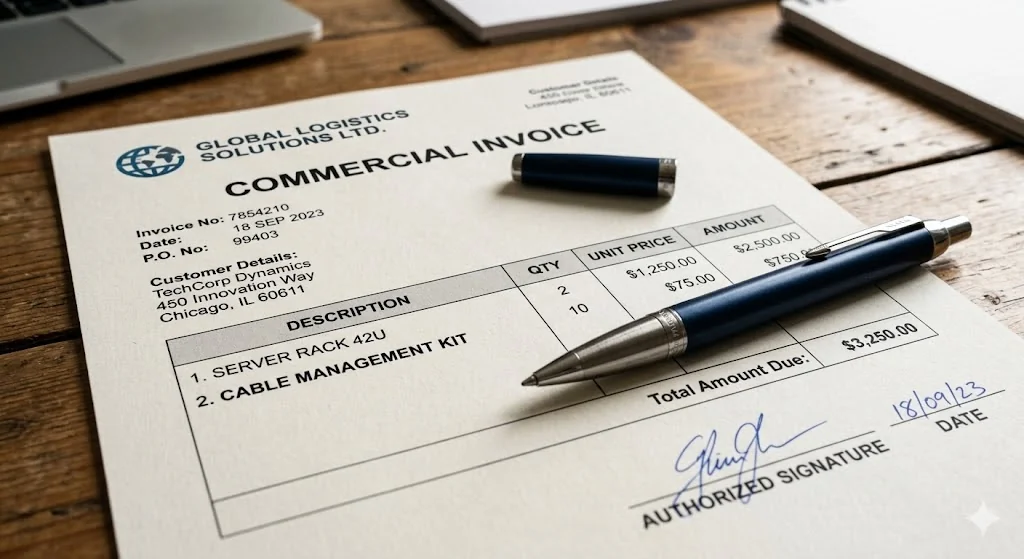
If there is one document that touches every single import shipment entering the United States, it is the commercial invoice. And yet, in 15 years of managing freight from Los Angeles to Frankfurt to Chicago, I have seen more customs delays, duty miscalculations, and CBP holds caused by a poorly prepared commercial invoice than almost any other compliance failure.
The frustrating part? Most of these problems are entirely preventable. The commercial invoice is not complicated — but it has to be right. Every line. Every time.
This guide walks you through each field of a commercial invoice, explains exactly what CBP is looking for, and shows you the mistakes that will cost you time, money, and margin.
What Is a Commercial Invoice and Why Does CBP Care So Much?
A commercial invoice is the primary document that U.S. Customs and Border Protection uses to assess duties, verify the value of your goods, confirm the country of origin, and determine whether your shipment is admissible into the United States.
Think of it this way: the commercial invoice is your shipment's story. It tells CBP who sold the goods, who bought them, what they are, where they came from, how much they are worth, and what they are made of. If any part of that story is missing or inconsistent, CBP has every right to stop your cargo and ask questions — and while they are asking, your container is sitting at the terminal running up demurrage charges.
The 10 Fields Every Commercial Invoice Must Have
1. Seller Information (Exporter)
This is the full legal name, address, and contact information of the party selling the goods. This must match the entity on your purchase order exactly. A mismatch between the seller on the invoice and the seller on your Letter of Credit or purchase order is one of the most common triggers for a CBP flag.
Common mistake: Using a trading company name instead of the actual manufacturer's name when the manufacturer is the true seller of record.
2. Buyer Information (Importer of Record)
Your full legal name and address as the importer of record in the United States. This must match the name on your customs bond and your IRS/EIN registration exactly. If you import under a business name, that business name — not your personal name — must appear here.
Why it matters: CBP uses this to verify that the correct party is paying duties and that the importer has a valid bond on file.
3. Invoice Date and Invoice Number
The invoice date establishes the timeline of the transaction. The invoice number is your reference for tracking this document through your customs entry, your freight forwarder's system, and your own records. Always use unique, sequential invoice numbers — duplicate invoice numbers across shipments are a red flag in automated CBP screening systems.
4. Description of Goods
This is the most critical field on the entire invoice. CBP requires a description that is specific enough to classify the goods under the correct HTS (Harmonized Tariff Schedule) code. Vague descriptions like "auto parts," "electronics," or "clothing" are not acceptable and will trigger a request for additional information.
Your description should include: what the item is, what it is made of, what it is used for, and any relevant specifications (dimensions, capacity, material composition).
Real example from my career: A client imported "steel components" for years without issue — until a CBP officer decided that description was insufficient and placed a hold on three containers simultaneously. The correct description should have been "cold-rolled steel brackets for industrial shelving systems." Specificity protects you.
5. Quantity and Unit of Measure
State the exact quantity and the unit of measure — pieces, kilograms, liters, sets, cartons. The quantity on the commercial invoice must match the quantity on the packing list exactly. Any discrepancy between these two documents is an automatic flag in CBP's Automated Targeting System.
6. Unit Price and Total Value
This is the declared customs value of your goods. CBP uses the transaction value method — meaning the price actually paid or payable for the goods. This is not your retail price, your insured value, or your estimated value. It is the actual price you agreed to pay your supplier, documented in your purchase order.
Important: If you are getting goods at a reduced price from a related party (a parent company, a subsidiary, or a long-term supplier with a special arrangement), CBP will scrutinize this closely. Related-party transactions require additional documentation proving the price was not artificially lowered to reduce duties.
7. Currency
State the currency of the transaction clearly — USD, EUR, CNY, etc. CBP will convert foreign currencies to USD using its own official exchange rate multipliers, published daily on cbp.gov. Your customs broker will apply the CBP rate in effect on the date of exportation. If your invoice is in a foreign currency, make sure your customs broker is using the correct conversion rate for the week of importation.
8. Country of Origin
This single field can determine your duty rate, your eligibility for free trade agreements like USMCA, and whether your goods are subject to Section 301 tariffs on Chinese imports. It must reflect where the goods were substantially manufactured — not where they were shipped from, not where your supplier is headquartered.
Critical point in 2026: With ongoing tariff scrutiny on China-origin goods, I have seen an increase in country of origin misrepresentation — goods manufactured in China being declared as Vietnam or Malaysia origin without meeting the substantial transformation test. This is customs fraud. It carries criminal penalties. Do not do it, and make sure your suppliers understand this.
9. HTS Code (Harmonized Tariff Schedule Number)
While technically the importer's customs broker is responsible for the final HTS classification, including the HTS code on your commercial invoice — and ensuring it is correct — saves time, reduces the risk of misclassification, and demonstrates good faith compliance to CBP.
If you are unsure of your correct HTS code, do not guess. Use CBP's free CROSS ruling database, consult your licensed customs broker, or book a classification review with a trade compliance specialist.
10. Terms of Sale (Incoterms)
State the agreed Incoterms — FOB Shanghai, CIF Los Angeles, DAP Chicago, etc. This tells CBP at what point in the supply chain title transferred and who was responsible for freight and insurance costs. These costs factor into dutiable value calculations under certain Incoterms.
Under FOB terms, freight costs from port of export onward are not included in the dutiable value. Under CIF terms, freight and insurance to the US port are included — which increases your customs value and therefore your duty amount.
The Three Lines Most Importers Miss
Beyond the ten required fields above, experienced compliance teams always include three additional lines that significantly reduce the risk of CBP questions:
First, the manufacturer's name and address — separate from the seller if they are different entities. Second, a statement of material composition for applicable goods — textiles, chemicals, and food products have specific content requirements. Third, any applicable license or permit numbers — for restricted goods like certain chemicals, firearms components, or agricultural products.
What Happens When Your Commercial Invoice Is Wrong
A commercial invoice error does not always mean an immediate hold — but it does mean one of three outcomes, none of which are free.
The best case is a CF-28 Request for Information, where CBP asks your broker to provide clarification. This typically adds 3–5 business days to your clearance time. The middle case is a CF-29 Notice of Action, where CBP adjusts your declared value or classification and assesses additional duties. The worst case is a formal customs exam, where your container is physically opened and inspected — costing anywhere from $800 to $3,500 in exam fees, plus any demurrage that accumulates during the examination period.
All three outcomes are expensive. All three are largely preventable with a correctly prepared commercial invoice.
My Recommendation: Build a Commercial Invoice Template
If you are importing regularly, stop accepting whatever invoice format your supplier sends and start providing them with your own template. A controlled template with pre-filled fields for your importer of record information, your preferred HTS codes for your standard products, and your Incoterms reduces errors at the source — before the shipment ever leaves the origin country.
I have helped clients cut their customs query rate by more than half simply by standardizing the commercial invoice format across all their suppliers. It is one of the highest-return compliance investments you can make.